Little Bastard
All the Bright PlacesLittle Bastard, Theodore Finch’s name for his mother’s Saturn VUE, is more than transportation: it repeatedly carries changes in his state and in his relationship with Violet Markey. Its journeys range from a dangerous drive that ends in a deliberate return to safety to cautious drives that help Violet move beyond fear. Later, when Theodore disappears, the car is left beside the Blue Hole, turning an object associated with motion into evidence of his absence.
Identity and Use
The car is an older Saturn VUE that Theodore drives around Bartlett and beyond. Its familiar name gives it a distinct presence in the narrative, while the contrast between its ordinary identity as a five-year-old minivan and Theodore’s imaginative experience of it as a sports car captures the scale of feeling he brings to driving. The car remains an everyday vehicle, but the scenes around it make its ordinary function unstable: it can offer access to another person, become an instrument of dangerous momentum, or stand abandoned when its driver has vanished.
The vehicle is also a mobile store of small, practical traces of Theodore’s life. When Violet climbs into it, she sees pencil stubs, pieces of paper, cigarette butts, a lighter, and guitar picks crowded into the center console. A blanket and pillow are in the back. These details make the car feel less like a neutral means of transport and more like a space he has occupied and used. Violet notices the contents; the scene lets her encounter part of his life without either of them needing to explain it.
Speed, Danger, and Return
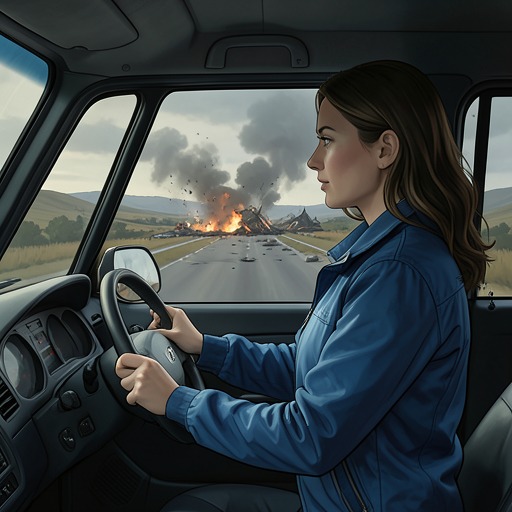
On an early drive to Violet’s house, Theodore takes Little Bastard along the farm road parallel to National Road and accelerates from sixty to seventy, eighty, and ninety miles per hour. He sets himself a threshold of one hundred, insisting inwardly that anything less will not count. The car’s shaking speedometer and its struggle to behave like a sports car place its physical limits beside his own increasingly absolute thinking. He experiences the speed as an intensification of being awake, but also recognizes that the drive could end disastrously.
At the precise point when the danger becomes acute, Theodore lifts his foot from the gas. Little Bastard sails over uneven pavement, lands hard, and stops partly in a ditch. He sits catching his breath, then notices that his hands are steady. Under the night sky, he registers the surrounding fields and houses and confirms to himself that he is still here. The car’s jolt is therefore both a consequence of the near-loss of control and the means by which the scene ends: the drive does not continue toward its chosen extreme. The car carries him back from that brink, and the moment makes its motion part of a larger contest between reckless acceleration and continued presence.
That same journey ends at Violet’s house, where she is waiting outside in a large coat. Theodore has come across town in only a few minutes, and their meeting begins with her reluctance to talk. The car thus connects the private crisis of the high-speed drive to a relationship that will repeatedly make movement possible for both of them. It does not resolve Violet’s distress on arrival, but it brings Theodore to her when she is alone and unwilling to claim that she needs help.
A Shared Space for Movement
When Theodore encourages Violet to drive again, Little Bastard becomes the setting for a careful, negotiated return to the road. Violet gets into the car and looks around at its clutter and the blanket and pillow in the back. She fastens her seat belt; Theodore asks her to close the door. He begins slowly, at barely twenty miles per hour, taking her through her neighborhood one block at a time. At each stop sign and light, he checks how she is doing. Only after these short stages does he pull onto National Road and increase their speed to thirty-five.
The car’s role here differs sharply from its role in Theodore’s earlier solo drive. Then, speed was a test he set for himself and pressed toward an extreme; with Violet, he proceeds by increments and makes room for her responses. Little Bastard gives her a controlled setting in which to attempt a feared action, while Theodore’s repeated check-ins make the ride collaborative rather than a demand that she recover all at once. The change in pace gives the vehicle a double association: it can magnify danger, but it can also support a measured return to ordinary life.
On another drive, Theodore suddenly takes the first exit he sees and pulls into the parking lot of East Township Public Library. He gets out, walks around to Violet’s side, and explains that he cannot wait. The abrupt stop shifts the car from a space of transit to a place where the pair confronts what is happening between them. The scene’s urgency belongs to the passengers, but the car makes the interruption concrete: their route is broken off, and they are left face to face beside the parked vehicle.
Little Bastard also carries the pair to the Blue Hole on the first warm day. Theodore brings their offerings, including the stubs of Violet’s SAT pencils and four broken guitar strings. He leads her up an embankment and down a hill to the water, a destination whose privacy and silence he wishes could belong to them alone. The car takes them to the starting point of this shared excursion; from there, their movement continues on foot. Across these journeys, it serves as a threshold between everyday routes and places or experiences the two enter together.
Flight and Disappearance
Later, after a family gathering, Theodore walks to his house, gets into Little Bastard, and drives without a map or destination. He travels through fields, turns north, west, south, and east, and pushes the car toward ninety miles per hour. By sunset he is returning toward Bartlett through Indianapolis. The sequence makes the car an instrument of aimless flight: unlike the rides with Violet, this journey has no shared destination or gradual plan.
When the driving no longer seems fast enough, Theodore pulls onto the shoulder and gets out. He bends over, waits, and then begins to run, leaving the car behind. The movement continues, but the vehicle can no longer contain or satisfy it. His attention turns to whether the car is locked and where his jacket might be, details that intrude as he runs harder. Little Bastard is not simply discarded in this passage; it remains an object of concern even as he moves away from it. The scene marks a striking reversal from the earlier drive with Violet, where the car’s speed was carefully moderated for her, and from the high-speed episode where Theodore eventually stopped accelerating and remained beside it.
When Violet later looks for him, she checks the refrigerator and kitchen island for a note, then opens the garage and finds it empty. Little Bastard is gone too. Its absence makes Theodore’s disappearance material: the empty garage does not tell her where he has gone, but the missing vehicle confirms that he has left. Violet then asks his sister Decca to tell her if she hears from him, gives her a phone number, and looks along the street for the car before leaving a voicemail for Theodore.
The Car as Clue and Memorial Trace
Violet eventually finds Little Bastard parked beside the road, its right wheels on the embankment. She sits in her own car with the ignition key in her fingers and considers driving away. The parked vehicle opens a gap between what she hopes and what the scene may mean: if she leaves, she can continue imagining Theodore elsewhere, still living and wandering. The car does not immediately settle that uncertainty. Its position holds her at the edge of knowledge.
The evidence around it is arranged with a care unlike the disorder Violet saw inside it earlier. Theodore’s clothes are folded and stacked on the bank. Violet kneels beside them, finds his dead phone tucked into one boot, and finds his glasses and car keys in the other. His jacket contains the map the two of them used for their wanderings, folded neatly like the clothes. She puts the map in her bag. Little Bastard has brought her to a place where the absent driver is represented by objects rather than by himself; the keys, in particular, connect the car to the ordered traces left at the water’s edge.
After Theodore is gone, Violet visits the remaining wandering sites, including the abandoned Pendleton Pike Drive-In. She parks her own car by the roadside and approaches the surviving screen from behind, imagining Theodore parking Little Bastard where she has parked and walking toward the same horizon-blocking structure. The imagined parallel links her present journey to his earlier one without making the two visits identical. At the drive-in, the car belongs to a remembered route and to the effort of reconstructing where Theodore went. Across the novel, its meaning changes with its use: it is first a vehicle for escape and risk, then a shared setting for tentative trust, and finally a silent marker around which Violet must face his absence.